
🔍 What is OCR ?
OCR (Optical Character Recognition) is a technology that converts an image document, whether scanned or photographed, into digital text. During this process, the text is directly integrated with the original document image, allowing it to be editable and searchable while keeping the original appearance.
OCR conversion process
Replacement of the original document: Once the OCR process is completed, the original document is replaced by the OCRed version. The text is integrated within the image, making the content both readable and interactive.
Impact on file size: The OCR process can cause an increase in file size because additional data is added to make the digital text editable and easily accessible.
Benefits of OCR
Content recognition and analysis: OCR enables the document to be both accessible and accurately recognized, thereby facilitating content analysis tasks such as summary generation.
Text search: Once the document has been processed with OCR, it becomes possible to perform text searches, thereby facilitating rapid access to specific information.
Key information:
While OCR technology is typically accurate, errors in recognition may still arise, particularly when the original document quality is suboptimal.
Layout: OCR can sometimes distort complex elements like tables or images, even though the text itself is correctly recognized.
Data protection: At Closd, all data is processed securely and in compliance with the platform’s highest data protection standards. For more information, please refer to our Closd Data Protection page.
Generate a summary from a scanned PDF
It is possible to request a document summary directly within the interface.
Here is what appears if the file is an image or a scanned PDF:
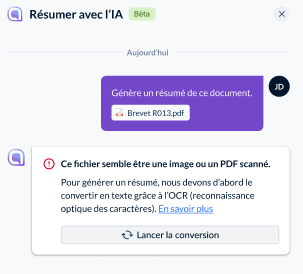
💡 If the document is an image or a scanned PDF, an OCR (Optical Character Recognition) conversion step must be triggered to enable the generation of the summary.